Starvard University · School of Music
Learn Piano
The complete course. From your first ten minutes to playing by ear.

Learn Piano
Start right now
Our Music Bot will walk you through your first notes, answer questions, and keep you company while you learn piano, right here on this page. No sign up. No audition. The president has approved it.
Open the Music Bot →It cannot play scales for you, but it will cheerfully watch you try.
Our Music Bot will walk you through your first notes, answer questions, and keep you company while you learn piano, right here on this page. No sign up. No audition. The president has approved it.
It cannot play scales for you, but it will cheerfully watch you try.
Open the Music Bot →Course Catalog, Vol. 1
Why Piano Is the Best First Instrument
President Worthington would like you to know that every other instrument is technically a piano that gave up halfway. We at the School of Music are more diplomatic: the piano is simply the clearest window into how music works.
Every note is laid out in front of you, left to right, low to high, in perfect order. On a guitar, the same note appears in three confusing places. On a piano, middle C is middle C, sitting there patiently, waiting for your thumb. The visual layout makes music theory obvious: you can see scales, see chords, and see the distance between notes. There is no other instrument where the theory is printed on the instrument itself.
The piano is also the only beginner instrument where you make a beautiful sound on day one. A violin beginner sounds like a goose filing for divorce. A piano beginner presses a key and gets a real note, full and true. You will play a real melody in your first ten minutes. We guarantee it, and our guarantee is backed by the full faith of the endowment jar.
One instrument, all of music
Melody, harmony, bass, and rhythm can all happen at once, under your two hands. A pianist is a one-person band with excellent posture.
It teaches every other instrument
Learn the piano and you learn scales, chords, rhythm, and reading music. Guitar, production, singing, and songwriting all get easier. Music schools make every student learn piano for exactly this reason, even the drummers.
It is endlessly deep
You can play "Twinkle Twinkle" in week one and still be discovering new things in year twenty. The ceiling is somewhere past the stratosphere. The floor is extremely comfortable.

Guest Lecturer
Dave's Approach: Ten Minutes a Day
This course exists because of how our chancellor actually learned. Dave Dlaney, the artist behind the one-year mission to learn five instruments and write fifty songs in public, started piano the way most adults should: in small, daily, honest sessions.
His rule is simple. About ten minutes of piano a day. Not an hour of suffering on Sundays, not a heroic three-hour session once a month. Ten minutes, every day, at the keyboard. Consistency beats intensity so thoroughly that it is not even a contest. Ten focused minutes daily will take you further in three months than weekend marathons ever will.
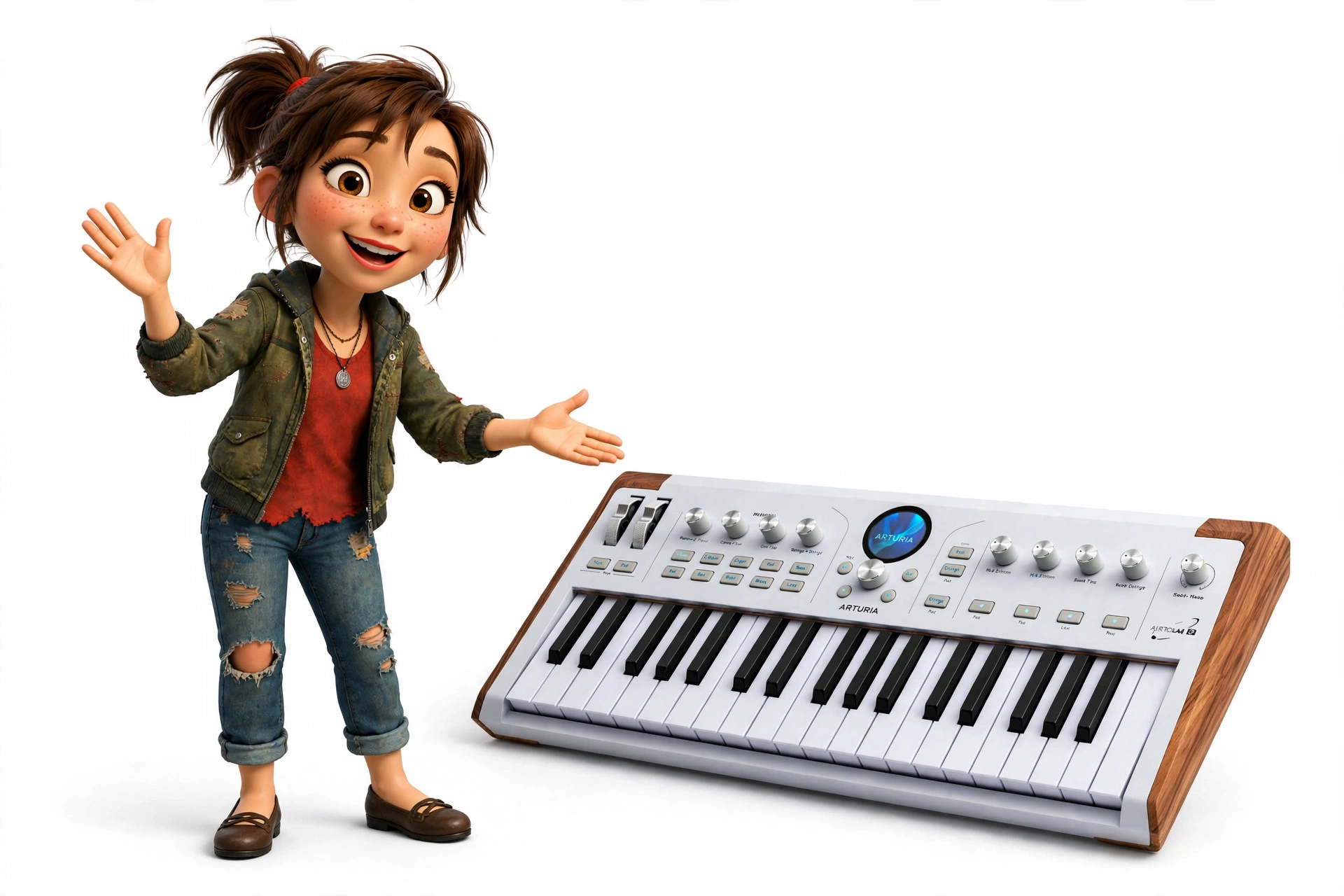
His setup is equally practical. He plays an Arturia AstroLab 37, a 37-key stage keyboard: small enough to live on a desk, serious enough to sound great. He pairs real keyboard time with two apps, Simply Piano for guided lessons and song learning, and Melodics for rhythm and timing drills that feel like a game. Apps plus real keys plus daily minutes: that is the whole system. It works because it is easy to start and easy to repeat.

Admissions Supplies
Choosing a Keyboard
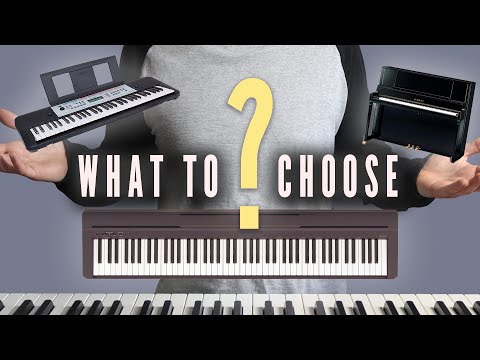
You do not need a grand piano. You do not need an acoustic piano at all. A decent digital keyboard is cheaper, quieter (headphones!), never needs tuning, and fits in an apartment. Here is what actually matters.
How many keys?
- 88 keys: the full piano. Best if you have the space and plan to play classical music seriously one day. Heavier and pricier.
- 61 keys: the sweet spot for beginners. Covers almost everything in this guide and nearly all pop music. Lighter, cheaper, desk-friendly.
- 37 keys (like Dave's AstroLab): compact and portable. Perfect for learning notes, chords, and songs, and for producers. You will eventually want more range, but you can learn a shocking amount on 37 keys.
- 25 keys: fine for sketching ideas, cramped for real piano learning. Start at 37 if you can.
Weighted vs. unweighted keys
Weighted keys feel like a real piano: heavier, with resistance, and they respond to how hard you press (this is called velocity sensitivity, and you want it). Semi-weighted is a good middle ground. Unweighted synth keys are light and springy: fine for learning notes and chords, less good for building finger strength and dynamics. If you can afford weighted or semi-weighted, get it. Your fingers will thank you.
What to look for on a budget
- Velocity-sensitive keys (non-negotiable, even cheap boards have this now)
- A sustain pedal input, and buy the pedal (about the price of a sandwich; it makes everything sound better instantly)
- A headphone jack, so you can practice at midnight like a responsible adult
- Built-in speakers are nice but not required
- USB or MIDI connection if you want to use learning apps like Simply Piano or Melodics
Campus Orientation
Setup and Posture
How you sit matters more than beginners think. Good posture prevents sore wrists, tense shoulders, and the mysterious backache that makes people quit in month two. The rules are simple:
- Bench height: sit so your forearms are roughly level with the keys, elbows slightly above the key surface. If you are reaching up or hunching down, adjust the bench or the keyboard stand.
- Distance: sit far enough back that your elbows have a slight bend, close enough that you are not leaning forward. Your belly button should be roughly in front of middle C.
- Feet: flat on the floor (right foot hovering near the sustain pedal when you use it).
- Back: straight but not stiff, leaning very slightly forward from the hips. Imagine a string gently pulling the top of your head toward the ceiling.
- Shoulders: down and relaxed. If they creep toward your ears, shake them out and reset.
- Wrists: level, floating, not drooping below the keys and not arched high. Think of holding a small ball under each palm.
Hand position: curve your fingers like you are holding a bubble, or a tennis ball, or the last slice of pizza you are protecting from roommates. Play on the tips of your fingers, not the flat pads. Thumbs play on their outer edge, slightly sideways. Nails short, please. The piano is not a typing test, and long nails make everything click and slide.

Lesson One
Your Hands, the Notes, and the Black-Key Pattern
Finger numbers
Pianists number their fingers instead of naming them, because "play with your tall one" gets confusing fast. Both hands use the same numbers:
| Finger | Number |
|---|---|
| Thumb | 1 |
| Index | 2 |
| Middle | 3 |
| Ring | 4 |
| Pinky | 5 |
So when this guide says "right hand 1-2-3," that means thumb, index, middle. Every scale fingering in this document uses these numbers.
The only seven letters in music
Music uses just seven note names, repeating forever: A, B, C, D, E, F, G, then back to A. The white keys on your keyboard are these seven notes repeating. The black keys have names too: each one sits between two white keys and takes its name from them, with sharp (#) meaning one step up and flat (b) meaning one step down. The black key between C and D is called C# (C sharp) or Db (D flat). Same key, two names. Musicians call these enharmonic equivalents, which is a fancy way of saying the key has an alias.
The black-key pattern: your map
Look at the black keys. They come in repeating groups of two, then three, then two, then three, all the way across the keyboard. This pattern is your compass:
- C is the white key immediately to the left of any group of two black keys.
- F is the white key immediately to the left of any group of three black keys.
- Middle C is the C nearest the center of the keyboard (on an 88-key piano, the fourth C from the left). It is home base for everything you learn first.
One octave: the white keys C D E F G A B, with their black-key neighbors.

Laboratory Session
Your First Ten Minutes at the Keys
Do this right now. Seriously, right now. Read each step, then do it.
- Find middle C. Locate a group of two black keys near the center of the keyboard. The white key to its left is C. Put your right thumb (finger 1) on it.
- Walk up the white keys. Play C, D, E, F, G with fingers 1, 2, 3, 4, 5 of your right hand, one finger per key. Then walk back down: 5, 4, 3, 2, 1. Congratulations: you just played a five-note scale. Repeat it a few times until it feels easy.
- Play all the Cs. Find every C on your keyboard and play them left to right, low to high. Notice they all sound like the same note, just higher or lower. Those are octaves.
- Make a chord. Put right-hand fingers 1, 3, and 5 on C, E, and G. Press all three at once. That is a C major chord, and it sounds like sunshine. Now move the whole shape up one white key each (D, F, A) and press again. That is D minor, and it sounds like a cloudy day. You just learned the difference between major and minor.
- Play a song. Scroll to the First Songs section below and play "Mary Had a Little Lamb." It takes about thirty seconds to learn.

Repertoire, Semester 1
First Easy Songs
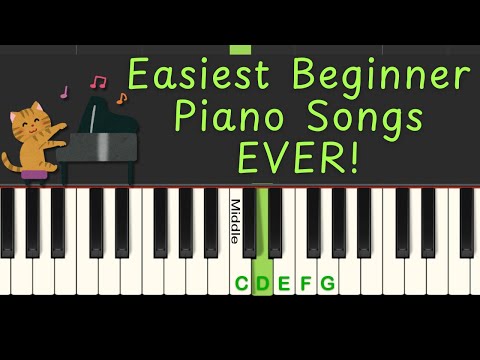
Start with your right hand only, one finger per note, beginning on middle C unless noted. Letters are note names. Play slowly; speed is the last thing you add, never the first.
Mary Had a Little Lamb
Hot Cross Buns (start on E)
Ode to Joy, by Beethoven (start on E)
Yes, that is real Beethoven. Yes, you can play it today. The president insists you tell people it is Beethoven, loudly, at parties.
Twinkle Twinkle Little Star
Heart and Soul (the duet everyone knows)
One person plays the chords, slowly, repeating: C, A minor, F, G. The other person plays the melody on top. This is the entire song. It has been played at approximately four million sleepovers.
Your first left hand
Once a melody feels easy, add the left hand playing just the root note of each chord, one per measure. For "Twinkle," play a low C under the first two measures, then a low G, then a low F, then a low G, then a low C. Melody in the right, roots in the left: you are now officially playing piano, both hands, like a professional who charges money.
Library Sciences
Reading Music
Sheet music looks like a secret code, and it is, except the secret is that it is extremely logical. You need three ideas: the staff and clefs, the note values, and time signatures.
The staff and the clefs
Music is written on five lines called the staff. Notes sit on lines or in the spaces between them. The clef at the start tells you which lines mean which notes.
- Treble clef (the curly one, for the right hand): the lines from bottom to top are E, G, B, D, F ("Every Good Boy Deserves Fudge"). The spaces are F, A, C, E (spells "FACE").
- Bass clef (the one that looks like a backward C, for the left hand): the lines from bottom to top are G, B, D, F, A ("Good Boys Deserve Fudge Always"). The spaces are A, C, E, G ("All Cows Eat Grass").
The two staves connect at middle C, which sits on a little extra line (a ledger line) between them. Together they form the grand staff: the full map of the piano.
Note values: how long is a note?
| Note | Name | Beats (in 4/4) | Looks like |
|---|---|---|---|
| O | Whole note | 4 | Open oval, no stem |
| |O | Half note | 2 | Open oval with stem |
| ●| | Quarter note | 1 | Filled oval with stem |
| ♪ | Eighth note | 1/2 | Filled oval, stem, one flag or beam |
| ♫ | Sixteenth note | 1/4 | Filled oval, stem, two flags or beams |
A dot after a note adds half its value again: a dotted half note lasts 3 beats, a dotted quarter lasts 1.5. Rests are silences, and they come in the same values (whole rest, half rest, quarter rest, and so on). Silence is part of the music. This is also true of conversation.
Time signatures
The two numbers at the start of a piece tell you how to count. The top number is how many beats per measure; the bottom number is which note value gets one beat.
- 4/4 ("four four," common time): 4 beats per measure, quarter note gets the beat. Count: 1-2-3-4. Most pop, rock, and hymns live here.
- 3/4: 3 beats per measure. Count: 1-2-3. Waltzes, and the feeling of spinning in a ballroom.
- 6/8: 6 eighth-note beats per measure, usually felt as two big beats (1-2-3, 4-5-6). Ballads and Irish jigs.

Department of Time
Rhythm and the Metronome
Rhythm is the difference between someone who "plays piano" and someone who plays piano. You can hit every right note and still sound wrong if the timing is off. Conversely, perfect timing makes even simple notes sound professional. Rhythm deserves your respect and about a third of your practice time.
Counting out loud
Count while you play: "1 and 2 and 3 and 4 and" for eighth notes in 4/4. Say the numbers on the beats and "and" between them. It feels silly. It works on everyone, including concert pianists, who all did this and would prefer you not mention it.
The metronome: your strictest, fairest teacher
A metronome clicks at a steady tempo, measured in beats per minute (bpm). It never speeds up when excited, never slows down at hard parts, and never lies to protect your feelings. Use it like this:
- Set it painfully slow, like 60 bpm. Play your piece or scale perfectly at that tempo.
- When it is easy, go to 66, then 72, then 80. Small steps.
- If you start making mistakes, you went too fast. Drop back down. There is no shame in 60 bpm; there is only shame in sloppy 120.
- Practice hard passages slower than the easy parts, not faster. Your fingers learn at the speed of accuracy.
Melodics, one of the apps Dave uses, is essentially rhythm training disguised as a video game. Ten minutes of timing drills there will do more for your groove than an hour of unstructured playing.

Mathematics Division
Scales That Matter
A scale is a ladder of notes that defines a key. Learn a scale and you learn which notes belong in a song, which chords work, and where your fingers go. You do not need all twelve major scales on day one. You need these five, which cover an enormous amount of real music.
Play each one hands separately first, slowly, with a metronome. The fingering numbers are the whole secret: they tell you exactly when to tuck your thumb under (going up) or cross fingers over (going down).
C major: the one with no black keys
Notes: C D E F G A B C. The pattern of a major scale is whole, whole, half, whole, whole, whole, half steps (a half step is one key to the next, black or white; a whole step is two half steps).
- Right hand: 1-2-3-1-2-3-4-5 (thumb tucks under after the 3rd finger)
- Left hand: 5-4-3-2-1-3-2-1
G major: one sharp
Notes: G A B C D E F# G. Same fingering as C major, both hands. The F# is the only black key. Notice how the fingering pattern transfers: learn it once, reuse it forever.
- Right hand: 1-2-3-1-2-3-4-5
- Left hand: 5-4-3-2-1-3-2-1
F major: one flat
Notes: F G A Bb C D E F. This one uses different fingering because the Bb changes where the thumb fits comfortably:
- Right hand: 1-2-3-4-1-2-3-4
- Left hand: 5-4-3-2-1-3-2-1
A minor: the sad twin of C major
Notes: A B C D E F G A. All white keys, same notes as C major, but starting on A. Every major scale has a relative minor that shares its notes; A minor is the relative minor of C major. Minor scales sound darker and are the sound of about half of all pop ballads.
- Right hand: 1-2-3-1-2-3-4-5
- Left hand: 5-4-3-2-1-3-2-1
The pentatonic scale: the cheat code
The major pentatonic is a five-note scale: in C, it is C D E G A. It is called pentatonic because "penta" means five, and music theorists love Greek. Here is why it matters: almost every note in it sounds good over almost any chord in the key. You can improvise a pleasant melody immediately just by wandering around these five notes. The five black keys alone form an Eb major pentatonic (Eb, Gb, Ab, Bb, Db), which means you can play a gorgeous improvisation using only black keys while your right hand does all the work and your left hand takes the credit.

Architecture School
Chords: The Buildings of Music
A chord is three or more notes played together. Chords are harmony: the emotional color under the melody. Learn a handful of chords and you can play thousands of songs, because most popular music is the same chords in different orders with different haircuts.
Triads: major and minor
A triad is a three-note chord built by stacking thirds (skipping every other note of the scale). The recipe:
- Major triad = root + major third + perfect fifth. It sounds happy, bright, resolved. C major = C, E, G.
- Minor triad = root + minor third + perfect fifth. It sounds sad, tender, moody. C minor = C, Eb, G. (The middle note drops one half step.)
Learn these eight triads first. They are the load-bearing walls of Western music:
| Chord | Notes | Type |
|---|---|---|
| C | C, E, G | Major |
| G | G, B, D | Major |
| F | F, A, C | Major |
| D | D, F#, A | Major |
| A minor (Am) | A, C, E | Minor |
| E minor (Em) | E, G, B | Minor |
| D minor (Dm) | D, F, A | Minor |
| Bb | Bb, D, F | Major |
Practice them as block chords (all notes together) and as broken chords (notes one at a time, rolling upward). Play each chord with right-hand fingers 1-3-5.
Inversions: the same chord, new shoes
A triad can be rearranged so a different note is on the bottom. Root position C major is C-E-G (C on the bottom). First inversion is E-G-C. Second inversion is G-C-E. Same three notes, three different flavors, and inversions let your hand move smoothly from chord to chord instead of jumping around the keyboard. Smooth chord changes are the sound of someone who knows what they are doing.
Seventh chords: adding spice
Add a fourth note a seventh above the root and the chord gets richer, jazzier, more emotional:
- Major 7th: C, E, G, B (Cmaj7). Dreamy, warm, the sound of a sunset over a campus you cannot afford.
- Dominant 7th: C, E, G, Bb (C7). Bluesy, restless, desperate to resolve. G7 (G, B, D, F) is the most useful dominant 7th in existence.
- Minor 7th: C, Eb, G, Bb (Cm7). Smooth, soulful, the sound of rain on a library window.

History of Everything
The Progressions Behind Every Song
A chord progression is a sequence of chords that repeats. Here is the open secret of popular music: a small number of progressions account for a staggering number of hit songs. Roman numerals describe chords by their position in the scale, so a progression works in any key.
I - V - vi - IV: the four-chord song
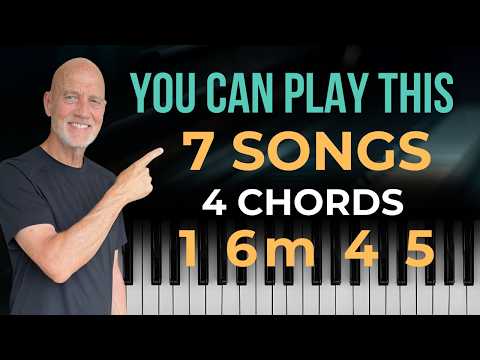
In C major, that is C, G, Am, F. This progression is behind hundreds of famous songs, from ballads to anthems. Play it as block chords, one per measure, and you will hear at least three songs you know within thirty seconds. In G major it is G, D, Em, C. The numbers stay the same; only the key changes.
I - vi - IV - V: the fifties progression
In C: C, Am, F, G. The sound of doo-wop, early rock and roll, and prom slow dances. Instantly nostalgic, even if you were not alive for any of it.
vi - IV - I - V: the emotional one
In C: Am, F, C, G. The sound of heartfelt choruses and montages where someone learns something important.
ii - V - I: the jazz progression
In C: Dm7, G7, Cmaj7. The backbone of jazz standards. If you can play this smoothly in a few keys, jazz musicians will nod at you with respect.
The 12-bar blues
Three chords, twelve measures, infinite songs. In C, using dominant 7ths:
That is the entire blues. Rock and roll grew directly out of this pattern. Learn it and you understand half the twentieth century.
Department of the Other Hand
Left-Hand Patterns
The left hand is the foundation crew: less glamorous than the melody, and the whole building falls down without it. These five patterns cover most situations a beginner will meet.
- Root notes: play the root of each chord, one per measure, in a low octave. Simple, strong, always correct. Your first month lives here.
- Root and fifth: alternate the root with the fifth above it (for C: C, G, C, G). Instantly more musical, the sound of folk and country accompaniment.
- Broken chords: play the chord notes one at a time, low to high (C, E, G, E, or C, E, G, C). Flowing and pretty, the sound of ballads.
- Alberti bass: root, fifth, third, fifth, repeating (C, G, E, G). The classical-era workhorse. Mozart used it constantly, and if it was good enough for Mozart, it is good enough for your practice room.
- Waltz pattern: in 3/4 time, play bass note, then chord, then chord (boom, chick, chick). One measure of C: low C, then C-E-G together twice. Instant ballroom.
Rule of thumb: the left hand plays less often than the right hand and lower than the right hand. When in doubt, simplify the left hand. A simple, steady left hand with a confident right-hand melody beats a fancy left hand with a lost melody every time.

Study Hall
How to Practice: A Real Daily System
Practice is not "playing until bored." Practice is a system with a beginning, a middle, and an end, designed so that every session makes you measurably better. Here is the Starvard Ten-Minute Method, modeled directly on how Dave learned:
The 10-Minute Session
- Minutes 0-2: Warm up. Play a scale you know, hands separately, slowly, with the metronome at 60. Wake the fingers up. No heroics.
- Minutes 2-5: One new thing. A new chord, a new scale, two measures of a song, one left-hand pattern. Small target, full attention. This is where growth happens.
- Minutes 5-9: Your song. Play the piece you are learning, slowly enough to play it correctly. Loop the hardest two measures five times. Slow is smooth, smooth becomes fast.
- Minute 9-10: Play something fun. Improvise on the black keys, replay a song you already know, make something up. End every session having enjoyed the piano. This is the most important minute.
The rules of the practice room
- Same time, same place, every day. Habit beats motivation. Motivation is a guest; habit pays rent.
- Slow down to speed up. If you cannot play it slowly, you cannot play it fast. You can only play it fast and wrong.
- Isolate the hard part. Do not replay the whole song when two measures are the problem. Loop the two measures. Then add one measure on each side. Then play the section.
- Hands separately, then together. Every hard passage gets learned one hand at a time first. This is not a beginner crutch; professionals do it too.
- End on a win. Never finish a session frustrated on a hard passage. Play something you know well, enjoy it, and walk away. Your brain consolidates overnight what you practiced today.
- Track the streak. Put an X on a calendar for every day you play. After two weeks of Xs, you will protect the streak like it is a small pet.

Degree Requirements
Your 30, 60, and 90-Day Plans
Ten minutes a day, following this plan, will take you from zero to a pianist who can genuinely play. Adjust freely; the plan serves you, not the reverse.
Days 1-30: Foundations
- Learn the note names, the black-key pattern, and middle C
- Play the C major five-finger pattern and then the full C major scale
- Learn C, G, Am, and F triads as block chords
- Play three songs from the First Songs section with the right hand
- Add left-hand root notes to one song
- Start counting out loud and try the metronome at 60 bpm
Graduation test: play "Ode to Joy" with both hands, steady tempo, no stops.
Days 31-60: Harmony
- Learn the G major and F major scales
- Learn all eight beginner triads, plus first inversions
- Play the I-V-vi-IV progression in C and G, smoothly
- Learn two left-hand patterns (root-fifth and broken chords)
- Learn one full song with chords in the left hand and melody in the right
- Begin reading simple sheet music, one song at a time
Graduation test: play a four-chord progression in two keys while a friend names random chords and you keep up. (Friends may need to be bribed.)
Days 61-90: Musicianship
- Learn A minor and the pentatonic scale; improvise over a I-V-vi-IV loop
- Learn G7 and the 12-bar blues in C
- Play the ii-V-I progression with seventh chords
- Learn to play a simple song by ear (start with "Happy Birthday")
- Record yourself playing a full song and listen back without flinching
- Play for another human being, even if it is your cat
Graduation test: sit at any piano, in front of any person, and play something start to finish. Congratulations, you are a pianist. The diploma is in the mail. (It is not in the mail.)

Advanced Studies
Ear Training and Playing by Ear
Playing by ear means hearing a melody and finding it on the keys without sheet music. It is not a gift; it is a trainable skill, and it starts embarrassingly small.
The method
- Start with "Happy Birthday." Everyone knows it. Hum the first phrase, then hunt for the first note on the piano. Try notes until one matches. Then find the second note relative to the first. Melodies are mostly steps (neighboring notes) with occasional leaps.
- Think in numbers. Most simple melodies in a major key can be described by scale degrees. "Mary Had a Little Lamb" in C is 3-2-1-2-3-3-3. Once you hear numbers instead of random notes, every song gets easier.
- Find the bass first for chords. The lowest note usually tells you the chord root. Hear a low C, try a C chord. This is how accompanists fake their way through songs they have never heard.
- Learn intervals. An interval is the distance between two notes. Start with the easy ones: octave (same note, higher), fifth ("Star Wars" theme opening), fourth ("Here Comes the Bride"), major third ("When the Saints" opening), minor second (the "Jaws" theme). Each interval has a personality; learn to recognize five and your ear is ahead of most beginners.
Daily ear exercises (two minutes)
- Play a note, sing it back. Then play two notes and sing both.
- Play a chord and name it major or minor without looking.
- Have the Music Bot (or a friend, or a random number generator) play a short melody; repeat it back on the keys.
Improvisation basics
Improvisation is just playing by ear in real time, and the pentatonic scale makes it safe. Put on a simple backing track or have a friend loop C, G, Am, F. Play only the notes C, D, E, G, A in the right hand, any rhythm, any order. It will sound good. That is not luck; the scale was designed (by centuries of musicians, not by the university, though we take credit) to avoid the notes that clash.
Rules for your first improvisations: play fewer notes than you want to, leave space between phrases (silence is a note you do not have to practice), end phrases on C (home), and repeat ideas you like. Repetition is not a lack of creativity; it is how melodies are born.

Academic Probation Office
Common Beginner Mistakes
The faculty has seen every one of these. Correction is gentle but firm.
- Playing too fast, too soon. The number one mistake, by a mile. Speed is a byproduct of accuracy. Practice slowly enough that you make zero mistakes, and speed arrives on its own schedule.
- Tension. Hunched shoulders, locked wrists, pressed fingers. If something hurts, stop. Shake out your hands, drop your shoulders, and play the passage slower and softer.
- Flat fingers. Collapsed finger joints rob you of control and tone. Curve the fingers, play on the tips. Check your hand shape in a mirror or your phone camera.
- Only practicing what you already know. Playing your favorite song for the twentieth time feels great and teaches nothing. The growth is in the hard two measures. Visit them daily.
- Ignoring rhythm. Beginners obsess over right notes and forgive wrong timing. Flip it: a simple part played in perfect time sounds professional; a complex part played out of time sounds like an accident.
- Never using the metronome. See above. The metronome is honest the way only machines and toddlers are honest.
- Looking at your hands constantly. Glance, do not stare. Learn to feel the geography of the keys. The black-key groups are landmarks; navigate by touch.
- Skipping the boring fundamentals. Scales and chords are vegetables. Eat them. Everything delicious in music is built from them.
Office Hours
When to Get a Teacher
You can learn an enormous amount alone, especially with apps like Simply Piano and Melodics and a guide like this one. But a good teacher, even for a few lessons, can fix in one hour what would take you six months to notice. Consider lessons when:
- You have been stuck on the same plateau for a month
- Something hurts when you play (technique issue, fix it early)
- You want to play classical repertoire properly
- You are preparing to perform or record
- You just want one: motivation with a human attached is powerful
A good teacher for an adult beginner listens to your goals, assigns pieces you actually like, and explains the why behind every exercise. A bad teacher assigns only exercises and makes you feel twelve years old. You are allowed to switch teachers. The university officially permits it, and we are very prestigious.

Frequently Asked Questions
FAQ
- Am I too old to learn piano?
- No. Adults learn faster than children at first, because they understand instructions and practice deliberately. Children have more free time and fewer opinions. You have the advantage.
- How long until I can play a real song?
- Today. "Ode to Joy" is a real song and it is in this guide. A song you love, played well, is typically three to six months away with daily practice.
- Do I need to learn to read sheet music?
- Not on day one, but yes, eventually. Reading opens up centuries of music and makes learning new songs dramatically faster. Learn it gradually, one song at a time, alongside everything else.
- Is ten minutes a day really enough?
- For the first year, yes, if the minutes are focused. Ten deliberate minutes beat an hour of noodling. When ten minutes starts feeling short, add more. It will.
- What is the difference between a keyboard and a piano?
- A piano makes sound with hammers hitting strings; a keyboard makes sound with electronics. For learning, a good weighted keyboard teaches you everything a piano teaches. Concert pianists may disagree, loudly, at dinner parties.
- Should I learn chords or reading first?
- Both, a little at a time. Chords get you playing songs fast, which keeps you motivated. Reading builds the deep skill that lasts. Alternate days if you must choose.
- Why do my hands not do what I tell them?
- Because they are learning a new language. The awkward phase lasts weeks, not years. Slow practice, hands separately, and patience. Your hands are not broken; they are students.
- What should I play for other people?
- Something you can play at 80 percent of your maximum difficulty. Performance nerves eat about 20 percent of your ability. Play the easy thing beautifully rather than the hard thing anxiously.

Reference Desk
Glossary
| Term | Meaning |
|---|---|
| Chord | Three or more notes played together |
| Triad | A three-note chord built by stacking thirds |
| Scale | An ordered ladder of notes defining a key |
| Octave | The distance from one note to the next same-named note; twelve half steps |
| Half step | The smallest distance in Western music: one key to the next |
| Whole step | Two half steps |
| Sharp (#) | Raises a note one half step |
| Flat (b) | Lowers a note one half step |
| Key | The home note and scale a piece of music is built on |
| Tempo | Speed of the music, measured in beats per minute |
| Dynamics | How loud or soft the music is |
| Arpeggio | A chord played one note at a time, usually in order |
| Inversion | A chord rearranged so a different note is on the bottom |
| Cadence | A chord sequence that feels like punctuation, especially at the end of a phrase |
| Relative minor | The minor key sharing all notes with a major key (A minor is relative to C major) |
| Pentatonic | A five-note scale, famously hard to make sound bad |
| Metronome | A device that clicks a steady beat; the strictest teacher you will ever love |
| Sustain pedal | The right pedal; holds notes after you lift your fingers |
| Ledger line | A short extra line for notes above or below the staff |
Commencement
Go Play
You now hold, in one document, everything a beginner needs: the notes, the fingers, the scales, the chords, the songs, the practice system, and the plan. It is a lot. Do not try to learn it all today. Learn one thing today. Then come back tomorrow and learn one more thing.
The piano does not care how old you are, how musical your family is, or how many instruments you failed at in middle school. It only cares that you sit down, today, for ten minutes. The keys are patient. They will wait. But you do not have to make them.
Keep learning
Talk through your first notes with the Music Bot, then return to the Starvard University homepage for the president's letter, the schools, and the endowment jar.
Ad astra per aspera, but make it fun.